One of the side effects of living alone (and having a generous friend with a good collection of DVDs to lend) is that I end up watching a lot of movies in the evenings. I am slightly ashamed to admit that not many of them have been in French, which is no doubt not the best way for me to immerse myself in the language, but Aurélie's collection is mostly English-language films, and a number of them were titles I had had on my list of things to see. So it goes...
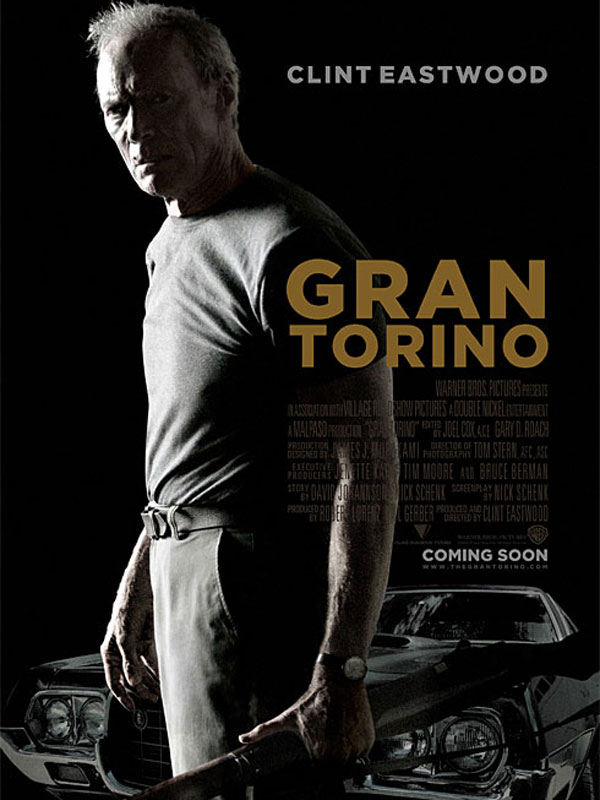
Most recently (i.e. tonight), I watched Gran Torino, a film which I had been meaning to see for a while, but had somehow not gotten around to it. I'm glad I finally watched it, although it was sad--not as sad as Million Dollar Baby, but still dark and heartfelt, about people struggling out of bleak and desperate situations and trying to find a way to live their lives as best they can. The film was not dark like a war-drama is dark; rather the bleakness was that of the ordinary lower working-class life, where the dangers of crime, violence, and loss of family hover just below the surface. For what it was, I thought the film was a success. Clint Eastwood is a great actor (and full of virility, even at 80), the character he played was a compelling one, and the relationship between him and the family of Hmong next door was portrayed in an affecting but not saccharine way (assisted by some good work by the supporting teenage actors).
However. I said Eastwood's character was compelling. That's not the same as his being likable. He was more or less an awful, racist old man. Although he always did the right thing when the situation called for it, I think that the question that I was left with after the movie was, where do you draw the line between the big character flaws and the little ones? How much prejudice can you get away with when you are moral about the big picture? And who defines the big picture? When should we ignore the differences in perspective between ourselves and other people, and when not?
Ultimately, the answer that the movie gave was that the important issues, the questions where your responses really matter, are those about maintaining your family, protecting the innocent, and doing right by your own life. Those are principles I can go along with, although I am not sure what the movie says about the importance of being armed in your own home. Parts of it were a little cowboy for me, but I was impressed with the twist at the end. I thought he was going to go all Death Wish in the final scene, and was pleased that he did not. It made the ending very poignant.
One last word about big versus little character flaws, and then I'll move on: Although Eastwood's character slung around a lot of racist epithets in the screenplay, during his one interaction with Afro-American teenagers, he did not use the n-word. I think if he had, it would have changed the way his character appeared, in terms of his ultimate moral make-up, at least to an American viewer. I am not sure what that says, that that is the prejudice we as a culture cannot look beyond and cannot forgive a person for displaying openly, or that it is still powerful enough, and the shadow of that particular oppression is so long, that that form of hatred cannot come up in movies without the entire movie having to be about it. Probably both.
Thursday, November 18, 2010
Tuesday, November 16, 2010
Transportation and the Ill Repute of High School Basements
I think it is time for me to talk about my bicycle. This is one of those things about my living situation here that is generally fortunate and user-friendly, but has some seriously annoying drawbacks.
When I first came to Cosne, I wanted to get, or at least have the use of, a bicycle for the duration of my time here. Cosne is too small to have or need a bus system, but there are times when I don't want to spend the twenty minutes it takes to walk across town to the train station or to the grocery store, let alone carry all my purchases back by hand. Besides, isn't it what one is supposed to do in France, bicycle around gaily with a baguette in the basket of one's velo?
I was fortunate, as with many of my amenities here at the school, to profit from the generosity of Mme. and M. Gordet, the school concierge and her husband who have been amazingly good to me, including lending me kitchen supplies, utensils, kitchen supplies, and even doing my laundry for me once a week. Mme. Gordet has, it turns out, a second bicycle, which she offered to loan me for the year. I am really fortunate to have such good and generous people hear at the school who are so willing to help me out, and with the bicycle I am now able to cycle precariously back from Carrefour market, my purchases lashed to the back wheel.
Those are the good sides to the situation. The slightly less good is that the bicycle is of an antediluvian age, and weighs maybe fifty pounds (I call it l'elephant). Also, there is no good overnight place on school grounds on which to keep it, so I have to lock it in the school basement. This presents two problems: 1) I have to carry it down stairs, and 2) My recent associations suggest that high school basements tend to be the source of scenes like this. I don't really think that the Lycée Pierre-Gilles de Gennes is built over what I suppose they would call a bouche d'enfer, but it is a little creepy, as you can see. I would hate to think that spending time down there would make me end up like this:
Although that would be an unfortunate end to my travels in France, I must admit that it is fairly unlikely, and the greatest risk I face from keeping l'elephant in the basement is that of banging my shin when I haul it out. In any case, it is nice to have the use of a bike here (baguette in handle basket optional).
When I first came to Cosne, I wanted to get, or at least have the use of, a bicycle for the duration of my time here. Cosne is too small to have or need a bus system, but there are times when I don't want to spend the twenty minutes it takes to walk across town to the train station or to the grocery store, let alone carry all my purchases back by hand. Besides, isn't it what one is supposed to do in France, bicycle around gaily with a baguette in the basket of one's velo?
I was fortunate, as with many of my amenities here at the school, to profit from the generosity of Mme. and M. Gordet, the school concierge and her husband who have been amazingly good to me, including lending me kitchen supplies, utensils, kitchen supplies, and even doing my laundry for me once a week. Mme. Gordet has, it turns out, a second bicycle, which she offered to loan me for the year. I am really fortunate to have such good and generous people hear at the school who are so willing to help me out, and with the bicycle I am now able to cycle precariously back from Carrefour market, my purchases lashed to the back wheel.Those are the good sides to the situation. The slightly less good is that the bicycle is of an antediluvian age, and weighs maybe fifty pounds (I call it l'elephant). Also, there is no good overnight place on school grounds on which to keep it, so I have to lock it in the school basement. This presents two problems: 1) I have to carry it down stairs, and 2) My recent associations suggest that high school basements tend to be the source of scenes like this. I don't really think that the Lycée Pierre-Gilles de Gennes is built over what I suppose they would call a bouche d'enfer, but it is a little creepy, as you can see. I would hate to think that spending time down there would make me end up like this:
Although that would be an unfortunate end to my travels in France, I must admit that it is fairly unlikely, and the greatest risk I face from keeping l'elephant in the basement is that of banging my shin when I haul it out. In any case, it is nice to have the use of a bike here (baguette in handle basket optional).
Sunday, November 14, 2010
Clara's Visit
My friend Clara from Lyon came to visit me this weekend. Of course, she is not really from Lyon, but from the Bay Area like me, but since Lyon is where I met her, and in terms of experience of and facility with French and French culture she is my sœur aînée, I think of her as "Clara from Lyon."
It was nice to be able to show a guest around my stomping grounds, although it did reinforce for me how small a town Cosne really is. There was a film festival going on at the lone cinema this weekend, which was pretty big news for Cosne, although a glance at the "red carpet crowds" will show the actual scale of the festivities. Clara and I did not actually end up attending any screenings at the festival; we were not particularly intrigued by any of the offerings, and since Clara had brought a judicious selection of her own recommended films, we ended up having what amounted to a personal film festival at my place over Friday and Saturday.
We watched two Russian films, both excellent--well made, powerfully acted, entertaining, and moving. The first, which I had heard of before but knew little about, was "Burnt by the Sun," a film made in the early years of greater openness just after the fall of the USSR, and set in 1930s Russia. It was primarily about the life of an upper class, military family, on the cusp of the time of the great purges, whose members both experienced bizarre continuities with pre-revolutionary, nineteenth-century Russia, and the devastating instability and brutality of Stalin's regime. It was a very somber film, as was the second (although Clara did point out that the latter left you with your faith in humanity slightly more intact). That one was called "Prisoners of the Mountain," and although I had never heard of it at all, it proved to be almost as good as the first. It was about two Russian soldiers in contemporary times, who were taken prisoner by Chechen rebels, and the expected and unexpected dramas that ensued. It turned out to be one of those films that was able to make you laugh with a particularly black humor, while never letting you forget dramatic weight of the story. All in all, it was a good weekend for film.
I would also add, as a side note, that both movies happened to include performances by Oleg Menshikov. He is an actor I had not heard of before, but I suspect I will be seeking out his performances is other films. Yum.
Besides having our fill of Russian films, Clara and I ate a lot of good food this weekend, both in Cosne, where we cooked on Friday night, and in Nevers, where we spent the second half of the weekend. We also had some good luck with touristing around Nevers on Sunday afternoon. Nevers, like many small French cities, is usually pretty dead on Sundays, but we were walking around after lunch with another friend and decided to step into the Cathedral, since it was well past the hours for mass. The Nevers Cathedral is quite impressive--bigger than the cathedral in the nearest large city, Dijon, it dates back to the thirteenth century--Mostly, that is, since the RAF accidentally knocked the roof in during a raid in June 1944. Not one of His Majesty's Air Force's finest moments, I have to say.
There was one good thing that came of the cathedral being partially destroyed, however, which we--by dint of a bit of serendipity--were able to find out about during our visit. When we arrived, the church was practically deserted, a great, empty, chilly stone structure with medieval buttresses and unappealing twentieth-century stained glass windows. As we were wandering among the different icons, though, we were approached by a little old Frenchwoman, very pleasant, who explained that she was the guide to the cathedral, and who told us that she had the key to the baptistère and would show it to us, if we liked. Unsure of what that meant, we said, "Why not?" She then proceeded to tell us the story.
Apparently, when victors of the Battle of Britain shelled the cathedral, they blew a rather deep hole in the floor on one side of the nave, and when the workmen were repairing it after the war, they found pieces of marble in the crater. This was odd, since the cathedral is made of a different stone, and they brought in archeologists to investigate. The archeological team dug deeper, and discovered the remains of an extremely old baptismal font, the center of a building that once stood on the site and that was constructed in the fifth century. The old lady took us down a set of stairs in one corner, and through a little door to show us the archeological site that has been uncovered--the base of an octagonal baptismal pool, which was once covered in gilded mosaics and surrounded by marble columns of different colors, and was visited by Christians who were still living under Roman rule. Our guide described to us what people surmise about the religious practices of the builders and the uses of the font, based on records of similar sites in other places, but we have no written records of the people who built or used this one. Nobody even knew it was there until friendly fire exposed the remains. It was amazing, looking at those ruins to think about how distant those early people were, how far removed from us by intervening time and loss of knowledge. It really was another world. At the same time, though, that world has not disappeared completely. There are ruins, and continuities of knowledge and of ritual, a fact which is equally astounding to think about.
It was nice to be able to show a guest around my stomping grounds, although it did reinforce for me how small a town Cosne really is. There was a film festival going on at the lone cinema this weekend, which was pretty big news for Cosne, although a glance at the "red carpet crowds" will show the actual scale of the festivities. Clara and I did not actually end up attending any screenings at the festival; we were not particularly intrigued by any of the offerings, and since Clara had brought a judicious selection of her own recommended films, we ended up having what amounted to a personal film festival at my place over Friday and Saturday.
We watched two Russian films, both excellent--well made, powerfully acted, entertaining, and moving. The first, which I had heard of before but knew little about, was "Burnt by the Sun," a film made in the early years of greater openness just after the fall of the USSR, and set in 1930s Russia. It was primarily about the life of an upper class, military family, on the cusp of the time of the great purges, whose members both experienced bizarre continuities with pre-revolutionary, nineteenth-century Russia, and the devastating instability and brutality of Stalin's regime. It was a very somber film, as was the second (although Clara did point out that the latter left you with your faith in humanity slightly more intact). That one was called "Prisoners of the Mountain," and although I had never heard of it at all, it proved to be almost as good as the first. It was about two Russian soldiers in contemporary times, who were taken prisoner by Chechen rebels, and the expected and unexpected dramas that ensued. It turned out to be one of those films that was able to make you laugh with a particularly black humor, while never letting you forget dramatic weight of the story. All in all, it was a good weekend for film.
I would also add, as a side note, that both movies happened to include performances by Oleg Menshikov. He is an actor I had not heard of before, but I suspect I will be seeking out his performances is other films. Yum.
![]() |
| Clara lighting the candles |
![]() |
| Stuffed peppers! |
Besides having our fill of Russian films, Clara and I ate a lot of good food this weekend, both in Cosne, where we cooked on Friday night, and in Nevers, where we spent the second half of the weekend. We also had some good luck with touristing around Nevers on Sunday afternoon. Nevers, like many small French cities, is usually pretty dead on Sundays, but we were walking around after lunch with another friend and decided to step into the Cathedral, since it was well past the hours for mass. The Nevers Cathedral is quite impressive--bigger than the cathedral in the nearest large city, Dijon, it dates back to the thirteenth century--Mostly, that is, since the RAF accidentally knocked the roof in during a raid in June 1944. Not one of His Majesty's Air Force's finest moments, I have to say.
There was one good thing that came of the cathedral being partially destroyed, however, which we--by dint of a bit of serendipity--were able to find out about during our visit. When we arrived, the church was practically deserted, a great, empty, chilly stone structure with medieval buttresses and unappealing twentieth-century stained glass windows. As we were wandering among the different icons, though, we were approached by a little old Frenchwoman, very pleasant, who explained that she was the guide to the cathedral, and who told us that she had the key to the baptistère and would show it to us, if we liked. Unsure of what that meant, we said, "Why not?" She then proceeded to tell us the story.
Apparently, when victors of the Battle of Britain shelled the cathedral, they blew a rather deep hole in the floor on one side of the nave, and when the workmen were repairing it after the war, they found pieces of marble in the crater. This was odd, since the cathedral is made of a different stone, and they brought in archeologists to investigate. The archeological team dug deeper, and discovered the remains of an extremely old baptismal font, the center of a building that once stood on the site and that was constructed in the fifth century. The old lady took us down a set of stairs in one corner, and through a little door to show us the archeological site that has been uncovered--the base of an octagonal baptismal pool, which was once covered in gilded mosaics and surrounded by marble columns of different colors, and was visited by Christians who were still living under Roman rule. Our guide described to us what people surmise about the religious practices of the builders and the uses of the font, based on records of similar sites in other places, but we have no written records of the people who built or used this one. Nobody even knew it was there until friendly fire exposed the remains. It was amazing, looking at those ruins to think about how distant those early people were, how far removed from us by intervening time and loss of knowledge. It really was another world. At the same time, though, that world has not disappeared completely. There are ruins, and continuities of knowledge and of ritual, a fact which is equally astounding to think about.
Thursday, November 11, 2010
War and Memory
Today is the 11th day of the 11th month. A holiday that I grew up with as Veteran's Day, which if I had any time off school at all, was lumped onto the nearest weekend to make it a three-dayer, and which, since I it is meant to honor the veterans of all foreign wars, was easily confused in my mind with Memorial Day. Not so here. This is very specifically Armistice Day, the anniversary of the end of what was supposed to be the war to end all wars.
I spent the night in Nevers last night, and when I finally made my way outdoors, into a very cold and rainy morning, it was just past 11. As I headed into the Place Carnot, the large square at the edge of the city center, I came upon a crowd of mostly older people, standing grouped around a statue that I had never really looked at before, but which I now realized was a memorial, with a female anthropomorphic personification (probably France, or possibly Liberty) standing by the side of a soldier. Today it was hung about with flags, and there was some kind of a ceremony going on at its foot, with speakers, a brass band, and military personnel--both army and navy--in uniform. I did not stay to watch the proceedings, mostly because I couldn't see more than the top of people's heads through the crowd, but after I had circled through the city center (to get a pain au chocolat, I admit) I came back to the Place Carnot to sit in the Cafe l'Agricole and watch the end of the ceremony through the window. It finished with all the the official participants forming up behind the band (which included a souzaphone and buglers whose horns were hung with blue, white, and red) and marching off down the street.
Watching that kind of an event I was struck by several things. One is that the dress uniforms for the French Navy are completely awesome. They include white berets with red pompoms and white spats. Unfortunately, I didn't have my camera with me, and when you google "French sailor uniform" the most appalling things come up, so I am not able to illustrate this point. You will have to take my word for it.
On a less frivolous note, witnessing the ceremony also made me think a little bit about how the world wars (both One and Two) are remembered very differently here. The event I saw was a very somber one, and that was not just, I think, because it was a cold gray day and the members of the citizenry who were interested enough to show up were older people. It really was a memorial, and not a vaunting of military glory. It made me think about the fact that the last war that took place on American soil passed out of living memory a long time ago. That is a big difference about being here. Of course, there aren't many people left who fought in World War II, let alone in World War I, but the memory still feels very close, especially of the second. There is another monument, not half a block from where I live in Cosne, that commemorates the site where a handful of members of the French Resistance were tortured, killed, and buried by the Nazis. That is not the sort of memory of a twentieth century conflict that you would see at home. All our wars are far away, in time or in space, and perhaps that helps us keep the awareness of their brutality at more of a distance. I am not saying that French culture does not have its own myths and blind spots about national conflicts (as I spent most of last fall having drummed into my head by the inestimable Carol Gluck, everybody has myths about the second world war and their part in it), but it is a different set of myths. Perhaps, as an outsider, I see them more acutely than somebody who has grown up with this memory of wars fought with battles and casualties practically on ones doorstep within the lives of our parents and grandparents.
I spent the night in Nevers last night, and when I finally made my way outdoors, into a very cold and rainy morning, it was just past 11. As I headed into the Place Carnot, the large square at the edge of the city center, I came upon a crowd of mostly older people, standing grouped around a statue that I had never really looked at before, but which I now realized was a memorial, with a female anthropomorphic personification (probably France, or possibly Liberty) standing by the side of a soldier. Today it was hung about with flags, and there was some kind of a ceremony going on at its foot, with speakers, a brass band, and military personnel--both army and navy--in uniform. I did not stay to watch the proceedings, mostly because I couldn't see more than the top of people's heads through the crowd, but after I had circled through the city center (to get a pain au chocolat, I admit) I came back to the Place Carnot to sit in the Cafe l'Agricole and watch the end of the ceremony through the window. It finished with all the the official participants forming up behind the band (which included a souzaphone and buglers whose horns were hung with blue, white, and red) and marching off down the street.
Watching that kind of an event I was struck by several things. One is that the dress uniforms for the French Navy are completely awesome. They include white berets with red pompoms and white spats. Unfortunately, I didn't have my camera with me, and when you google "French sailor uniform" the most appalling things come up, so I am not able to illustrate this point. You will have to take my word for it.
On a less frivolous note, witnessing the ceremony also made me think a little bit about how the world wars (both One and Two) are remembered very differently here. The event I saw was a very somber one, and that was not just, I think, because it was a cold gray day and the members of the citizenry who were interested enough to show up were older people. It really was a memorial, and not a vaunting of military glory. It made me think about the fact that the last war that took place on American soil passed out of living memory a long time ago. That is a big difference about being here. Of course, there aren't many people left who fought in World War II, let alone in World War I, but the memory still feels very close, especially of the second. There is another monument, not half a block from where I live in Cosne, that commemorates the site where a handful of members of the French Resistance were tortured, killed, and buried by the Nazis. That is not the sort of memory of a twentieth century conflict that you would see at home. All our wars are far away, in time or in space, and perhaps that helps us keep the awareness of their brutality at more of a distance. I am not saying that French culture does not have its own myths and blind spots about national conflicts (as I spent most of last fall having drummed into my head by the inestimable Carol Gluck, everybody has myths about the second world war and their part in it), but it is a different set of myths. Perhaps, as an outsider, I see them more acutely than somebody who has grown up with this memory of wars fought with battles and casualties practically on ones doorstep within the lives of our parents and grandparents.
Saturday, November 6, 2010
Avec mes souvenirs, j'ai allumé la feu...
...Mes chagrins, mes plaisirs, je n'ai plus besoins d'eux...
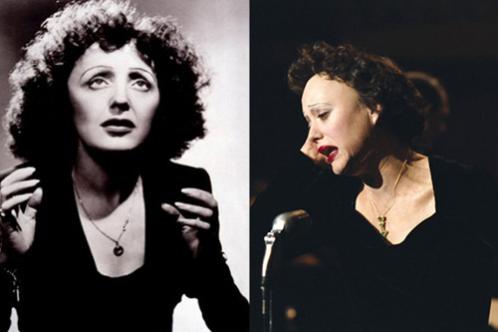
| On the one side, La Môme herself, on the other, Marion Cotillard in the 2007 film. |
I just finished watching "La Vie En Rose," or "La Môme," as it is called in its French distribution. It was not the easiest film to watch, mostly because the bare framework of events of the artist's life were so bitterly painful. Not only did the misfortunes of Edith Piaf's life use her up, but she used herself harshly as well--living experience to the hilt, yes, but also destroying her body in the process, so that by the time she died at 48 she was so wasted and frail she could have been 85. Aside from the dolorous subject, the film itself was difficult to follow (and not just because I am still struggling to understand all the French vocabulary). The narration jumped backwards and forwards in time so much that it was almost impossible to get a sense of the causes and effects of events. People came into and fell out of Piaf's life, and it was very hard to understand the whys and the wherefores of it all, let alone her responses to specific events outside of a general passionate imperiousness and brutal suffering. Perhaps the crazy-quilt sensibility was the intention, though--it certainly suggested the chaotic and unstable nature of Piaf's existence, and the way that good fortune and calamity both seemed to fall out of the sky onto her head.
I have a lot of impatience with the profusion of celebrity biopics in recent years, and with the assumption that an actor is accomplishing a great feat when they take on what could be argued is merely an impersonation or caricature. Isn't it a greater feat as an actor to make the audience believe in the vitality and the verisimilitude of an imaginary person? I could go on a length, but the NY Times review of the movie expresses my criticisms on that front a lot better here.
Although I agree with that critic's point about biopics, I am not sure about his assertion that American's cannot appreciate how great a star Piaf was. This American certainly does, and--although I definitely had my reservations about the film--I thought that the amount of her actual music that it included made in an experience well worth its limitations. Marion Cotiallard is a fiery actress, and she channeled a lot of brimstone for the role, but I though the real star of the film was the actual recording of Piaf's voice. Her songs lifted up the film, and brought it together. Milord, L'hymne à l'amour, L'accordioniste .... As I watched, I waited for the great songs to come on, one by one, and finally, at the end, when I knew it was coming, she sang the greatest: Non, je ne regrette rien.
Thursday, November 4, 2010
The End of Vacation
I am finally back in Cosne-Sur-Loire, after what seems like a very long time, even though it was only a week and a half. I am certainly not complaining about having vacation, but I was getting tired of living out of a suitcase (Omar, however, does not seem to have a problem with it)
I took that picture when I was in the final throes of repacking my suitcase, yet again, at Aurélie's place in Nevers. Every stop I made on the trip, this task became harder, because I kept adding to the things I had to fit inside my suitcase--a bottle of wine from Kellen's vineyard, a new skirt from Promod, a comic book.... Graphic novels, or bandes dessinés are HUGE here, which warms the cockles of my geeky heart. I certainly picked up enough souvenirs of les vacances de Toussaint, enough that now I have to practice a little more frugality, at least until the end of November. Being a tourist is certainly not the best way to save money!
Tourism can certainly be fun, though, although I always have to force down my fear of appearing to be the ugly American with a camera in order to get the pictures I know I will appreciate afterward. The past Monday was an especially good day for photos. It was my last full day in Lyon, and I was staying once again with Clara. I had come into the city the night before to attend her Halloween party (a cultural ambassadorship of sorts, with delicious home-cooked food), and because November 1st was a school holiday for her we were able to spend the day together. Unfortunately, everybody else was on holiday too, so there was a distinct lack of open shops, museums, and restaurants. We were, by good fortune and after much searching, able to find a good lunch at a delightful little place that Clara remembered and recommended. It was pleasant for it's decor as much as for it's food--eating there was like sitting inside of a vintage hatbox; it was all pink and cream and little wicker chairs, and it reminded me a bit of Kitchenette in NYC.
After lunch, tried to go to the park, an effort which included rides on several buses and a tram, and an embarrassing amount of walking around with no idea where we were. We finally did get there, though, and it was well worth our perseverance. The time of year was just right for the leaves to be breaking into golds and oranges, although they had not yet begun to fall from the trees, and so we had many gorgeous views of autumn foliage. The place was also full of people; partly, I imagine, because everything else was closed and everybody's children were out of school, but also because it seemed to be a very community-friendly site. There were lots of things that would have made me clamor to go to the park and have adventures, if I was under ten: a zoo, a little paddle boat pool, a pond with ducks to feed...Of course, you didn't have to be under ten to enjoy it: Clara and I paid two euros each to ride a little train that went at the thrilling speed of a middle-aged jogger and took us all the way around a little island in the middle of the park's lake. Very nostalgic and satisfying.
I took that picture when I was in the final throes of repacking my suitcase, yet again, at Aurélie's place in Nevers. Every stop I made on the trip, this task became harder, because I kept adding to the things I had to fit inside my suitcase--a bottle of wine from Kellen's vineyard, a new skirt from Promod, a comic book.... Graphic novels, or bandes dessinés are HUGE here, which warms the cockles of my geeky heart. I certainly picked up enough souvenirs of les vacances de Toussaint, enough that now I have to practice a little more frugality, at least until the end of November. Being a tourist is certainly not the best way to save money!
Tourism can certainly be fun, though, although I always have to force down my fear of appearing to be the ugly American with a camera in order to get the pictures I know I will appreciate afterward. The past Monday was an especially good day for photos. It was my last full day in Lyon, and I was staying once again with Clara. I had come into the city the night before to attend her Halloween party (a cultural ambassadorship of sorts, with delicious home-cooked food), and because November 1st was a school holiday for her we were able to spend the day together. Unfortunately, everybody else was on holiday too, so there was a distinct lack of open shops, museums, and restaurants. We were, by good fortune and after much searching, able to find a good lunch at a delightful little place that Clara remembered and recommended. It was pleasant for it's decor as much as for it's food--eating there was like sitting inside of a vintage hatbox; it was all pink and cream and little wicker chairs, and it reminded me a bit of Kitchenette in NYC.After lunch, tried to go to the park, an effort which included rides on several buses and a tram, and an embarrassing amount of walking around with no idea where we were. We finally did get there, though, and it was well worth our perseverance. The time of year was just right for the leaves to be breaking into golds and oranges, although they had not yet begun to fall from the trees, and so we had many gorgeous views of autumn foliage. The place was also full of people; partly, I imagine, because everything else was closed and everybody's children were out of school, but also because it seemed to be a very community-friendly site. There were lots of things that would have made me clamor to go to the park and have adventures, if I was under ten: a zoo, a little paddle boat pool, a pond with ducks to feed...Of course, you didn't have to be under ten to enjoy it: Clara and I paid two euros each to ride a little train that went at the thrilling speed of a middle-aged jogger and took us all the way around a little island in the middle of the park's lake. Very nostalgic and satisfying.
Saturday, October 30, 2010
Mice and the Middle Ages
It is a rainy morning here, the sort of weather that makes you glad you can sit inside and drink tea without having to worry about going anywhere. It's good for a lazy vacation Saturday, although I'm glad it held off yesterday. Aurelie took me to see a nearby village called Pérouges in the afternoon, which had preserved almost in its entirety its midieval architecture. Walking through the little slanting streets over stones that I would hate to think of trying to pull a cart over, it was as if we had slipped beneath the layers of development of the last 500 years and were catching glimpses of the way the village might have looked in the days when towns of burgers were first beginning to form, creating environments where commercial relations took on nez power and the old feudal ties of landed lord and hereditary vassel began to decay. Townships like this, which look like the antithesis of modernity to us today, were actually the cutting edge of developments that would lead to secularism, captitalism, revolution, and a host of other big concepts--at least if my stuffy, Intro to the Later Middle Ages professor of last year is to be believed.
Not everything in Pérouges was a relic, though, and I came upon this personal vehicle that would have fit right in in my home town:
Because it was the off season, and a cold and windy day the town was relatively empty, with the tourist museums shut, and the only visitors the few families who had brought their children to wander the streets. (I imagine that, as a six-year-old, this would be an even more awesome place to visit). The quiet was actually quite nice, though, and it felt appropriate to the setting. Aurélie and I did some exploring >>...Then we went to taste the town specialty (Aurélie said, "Of course every little town in France has their own food that is a particular product of the locale"). In this case it was the galette de Pérouges, a sort of a flat cake baked with sugar on top, something like a sweet pizza. We tried it, along with tea and coffee, at a little restaurant that had been serving the same cake since it opened in 1912. The interior definitely suggested that little had changed there in the last 98 years. The walls were decorated with old-fashioned china and brass cookware and the waitresses with lacy aprons and little caps, and we were able to warm ourselves in the heat of a large open hearth while we ate.
Unfortunately, we were not the only ones to treat ourselves yesterday. The other adventure of the day was an escapade of Aurélie's cats. She has two, brother and sister, who she brought with her from Nevers for the holidays, and who are enjoying the country life a little too much. While we were sitting watching a movie after dinner that evening, Omar, came trotting in from the garden to show us what he had found--a mouse, and one that had not yet succombed to his attentions! We proceeded to have very girly responses (squealing, and staying out of the way), while Omar began to enjoy himself with the poor mouse, letting it run here and there, and then catching it again, while it sqeaked pitifully. After a while we convinced him to take it outside to finish it off, and we were just breathing a sigh of relief, when he brought it back again, still alive. This time I, after much dithering, tried to rescue the mouse, using a dustpan and a rolled-up magazine, which prompted Omar to take it outside again. This happened about three more times--mouse came in, made brief and increasingly failing runs for freedom, I approached with the dustpan, and Omar retreated, carrying his prize. At last he came in and, having decided that the game was over, finally killed the mouse and proudly ate it in front of us. There was a lot of crunching.
Relieved that it was finally over, we were settling back to watch the movie, when Biscotte, who had been watching Omar jealously the whole time, trotted in with her own mouse!! Mercifully, this one had already given up the ghost, bu Biscotte was determined that this would not spoil her fun, and she commenced to play with it, flinging the corpse the air and leaping about while we groaned and tried to avert our eyes. After far too long (for us) she finally gave up and polished off her own as well, but it was rather too much like being a spectator at the Roman games for my taste. I know they're cats and they can't help their nature, but still...!
![]() |
| Biscotte, looking innocent--don't be fooled! |
Subscribe to:
Posts (Atom)